Something Big Is Happening in AI (And What It Means)
Last week, a post on X went viral. Over 80 million views in a few days. The author, Matt Shumer, CEO of HyperWrite and someone who’s been building AI tools for six years wrote something that struck a nerve.
His message was simple: “I’ve been giving you the polite version about AI. The honest version sounds like I’ve lost my mind.”
I rarely see an idea spread this fast. Not because it was sensational, but because it named something people in tech have been feeling but not saying out loud.
Shumer compares this moment to February 2020 – just before COVID changed everything. Back then, a few people saw what was coming. Most dismissed it as overblown. Then reality hit in three weeks.
His claim? We’re in that same “this seems exaggerated” phase with AI.
One Topic: Something Big Is Happening in AI
What Actually Changed
On February 5, 2026, two major AI models dropped on the same day: GPT-5.3 Codex from OpenAI and Claude Opus 4.6 from Anthropic.
Shumer describes what happened next. He tells the AI what he wants to build. Walks away for four hours. Comes back to production-quality work. No back-and-forth needed. No corrections.
Here’s the part that got everyone talking: OpenAI confirmed that GPT-5.3 Codex was “instrumental in creating itself.” The AI helped debug its own training, managed its deployment, diagnosed test results.
AI is now building the next AI.
When you have systems that can contribute to their own development, progress doesn’t just speed up, it compounds. Anthropic CEO Dario Amodei says AI is already writing “much of the code” at his company, and the feedback loop is “gathering steam month by month.”
The Data Behind the Hype
There’s a research group called METR that tracks AI capability growth. They measure how long and complex a task an AI can complete autonomously.
The numbers tell a clear story:
- In 2019, AI failed tasks that took humans 1 minute
- By early 2025, AI handled tasks taking about 1 hour
- By late 2025, that jumped to 5 hours
- Capability doubling time dropped from 196 days to 88.6 days
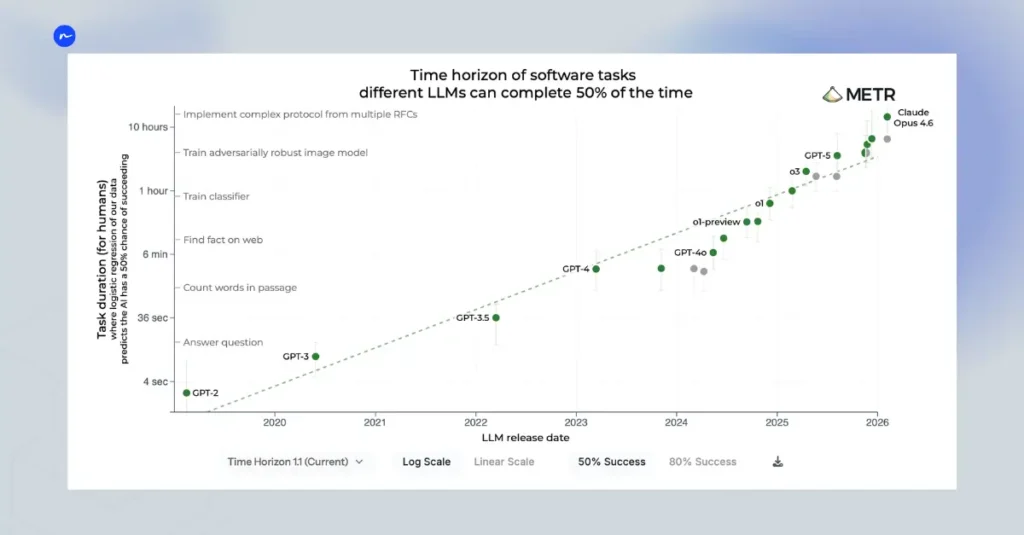
If this trend holds and it has for years – we’re looking at AI handling day-long projects within a year, week-long projects within two years, month-long projects within three.
Amodei’s prediction? AI could eliminate 50% of entry-level white-collar jobs within 1-5 years.
The Pushback (And Why It Matters)
Not everyone agrees with Shumer’s urgency.
AI researcher Gary Marcus called similar claims “weaponised hype,” arguing current models are powerful but nowhere near fully replacing complex human work. He stresses AI can speed certain tasks but doesn’t replicate the full depth of human understanding and judgment.
This debate is important. One side says AI’s impact will be gradual, augmenting rather than replacing work. The other says white-collar roles could be deeply disrupted in the next couple of years.
Interestingly, Microsoft AI CEO Mustafa Suleyman recently predicted that “most, if not all” white-collar tasks could be automated within 12-18 months. If valid, that’s not decades – that’s this year and next.
The gap between these views shows how uncertain the timeline really is. But here’s what both sides agree on: something is shifting, and it’s shifting faster than public perception.
Two Faces of the Same Shift
Here’s what I’m observing: AI progress has two faces – tremendous opportunity and real disruption.
On one hand, people using the latest models are seeing productivity gains that would’ve seemed impossible a year ago. They’re creating output at speeds that change what’s possible in a day of work.
On the other hand, certain kinds of work aren’t “safe” just because they feel complex or knowledge-heavy. If most of what you do happens on a screen – reading, analysing, writing, coding – you’re in the zone where AI can assist and, soon, outperform.
Fields already seeing impact:
- Legal work: contract analysis, research, brief drafting
- Financial analysis: model building, data interpretation
- Software engineering: complex multi-file projects
- Content and marketing: campaigns, documentation
- Customer service: multi-step problem resolution
This isn’t doom. It’s a signal.
What This Actually Means for You
I’m not here to predict either extreme – collapse or utopia.
What I can tell you based on what’s happening right now:
You don’t need to panic. You do need to pay attention.
AI isn’t a distant future story anymore. It’s influencing real work today. People are adapting faster when they use AI now, not wait.
The bigger question isn’t whether AI will change work – it’s how fast you’re preparing yourself.
My recommendation?
Don’t take anyone’s word for it. Get access to Claude Opus 4.6, Gemini 3.1 Pro, Kimi K2.5 or GPT-5.2/5.3. Make sure you’re using the most capable model, not the default. Then give it real work from your job.
Watch what happens. Not whether it’s perfect, but how much it can already do and how quickly it’s improving.
Shumer’s advice resonates: Spend one hour a day experimenting with AI for six months. Not reading about it. Using it. You’ll understand what’s coming better than 99% of people around you.
The people who adapt early won’t be the ones with perfect predictions. They’ll be the ones who noticed the shift before it showed up in their performance review.
Whether Shumer’s timeline is right or Marcus’s skepticism is warranted, one thing is clear: this moment feels different from previous tech waves.
And the window to adapt intentionally, rather than reactively, is open right now.
Read original X Post from Matt Shumer
Interested in travel or photography, read last week’s LensLetter newsletter about Stop Shooting and Start Telling Stories.
Read last week’s JustDraft about GPT-5.3 Codex & Claude Opus 4.6 Features.
Two Quotes to Inspire
The leaders who thrive in uncertainty aren’t the ones with all the answers, they’re the ones comfortable being beginners again and again.
Strategy isn’t about predicting the future perfectly. It’s about building the capacity to respond faster than the future changes.
One Passage From My Bookshelf
We expected that good-to-great leaders would begin by setting a new vision and strategy. We found instead that they first got the right people on the bus, the wrong people off the bus, and the right people in the right seats and then they figured out where to drive it. The old adage ‘People are your most important asset’ turns out to be wrong. People are not your most important asset. The right people are.
Indeed, when we began the research project, we expected to find that the first step in taking a company from good to great would be to set a new direction, a new vision and strategy for the company, and then to get people committed and aligned behind that new direction. We found something quite the opposite. The executives who ignited the transformations from good to great did not first figure out where to drive the bus and then get people to take it there. No, they first got the right people on the bus (and the wrong people off the bus) and then figured out where to drive it.
When you have the right people on the bus, the problem of how to motivate and manage people largely goes away. The right people don’t need to be tightly managed or fired up; they will be self-motivated by the inner drive to produce the best results and to be part of creating something great.
From “Good to Great” by Jim Collins