The Four Burners Theory: You Cannot Have It All (But You Can Rotate)
For years, you probably believed balance was just a scheduling problem. If you planned better, worked smarter, or woke up earlier, you could do justice to everything.
Then comes the Four Burners Theory (popularised by James Clear). And it forces an uncomfortable truth.
Life has four burners running on the same stove: family, friends, health, and work. The idea is simple. You cannot run all four at full power at the same time. There is limited fuel. If one burner goes up, another has to come down.
At first, this sounds harsh. But the longer you sit with it, the more accurate it feels.
One Topic: Four Burners Theory
Why This Idea Sticks
Time and energy are finite. That part is not philosophical. It is math. When work expands, something else shrinks. When health becomes a focus, evenings disappear. When family needs attention, friendships often go quiet.
Research backs this up. Long work weeks reduce social time. Intense personal goals create short-term imbalance. Nearly nine out of ten professionals report burnout at some stage, often because they try to keep all burners high for too long.
So yes, trade-offs are real.
Where the Four Burner Theory Goes Wrong
The danger begins when you treat this theory as permanent advice. Many take it to mean: “If I want success, I must shut down one or two burners for good.” That is where regret enters.
Studies on later-life reflection show a clear pattern. People rarely regret working hard for a season. They regret never returning to what they put aside. Health neglected too long becomes hard to rebuild. Friendships left untouched quietly fade. Family time does not compound the way money does. Research shows 75% of people over 70 regret permanently sacrificing one or more burners during their careers. Three out of four people looking back wish they had done things differently.
The real issue is not sacrifice. It is permanent sacrifice without intention.
Burners Are Not Equal
Another flaw is assuming all burners carry the same weight. They do not.
Health is the base. Without it, the other three weaken fast. Work is flexible. It can stretch and recover. Relationships are fragile. They need steady care, not bursts. James Clear puts it this way: “Work is a rubber ball. If you drop it, it bounces back. Family, health, and friends are made of glass. Drop them, and they crack.”
This changes how you think about priorities. The question is no longer “Which burner do I cut?” It becomes “Which burner can safely run lower for now?”
A Better Way to Think About It
Instead of cutting burners off, three approaches work better over time.
1. Seasons, Not Balance
Life moves in phases. There are periods when work dominates, others when family or health must lead. What matters is knowing the season you are in and deciding when it will end.
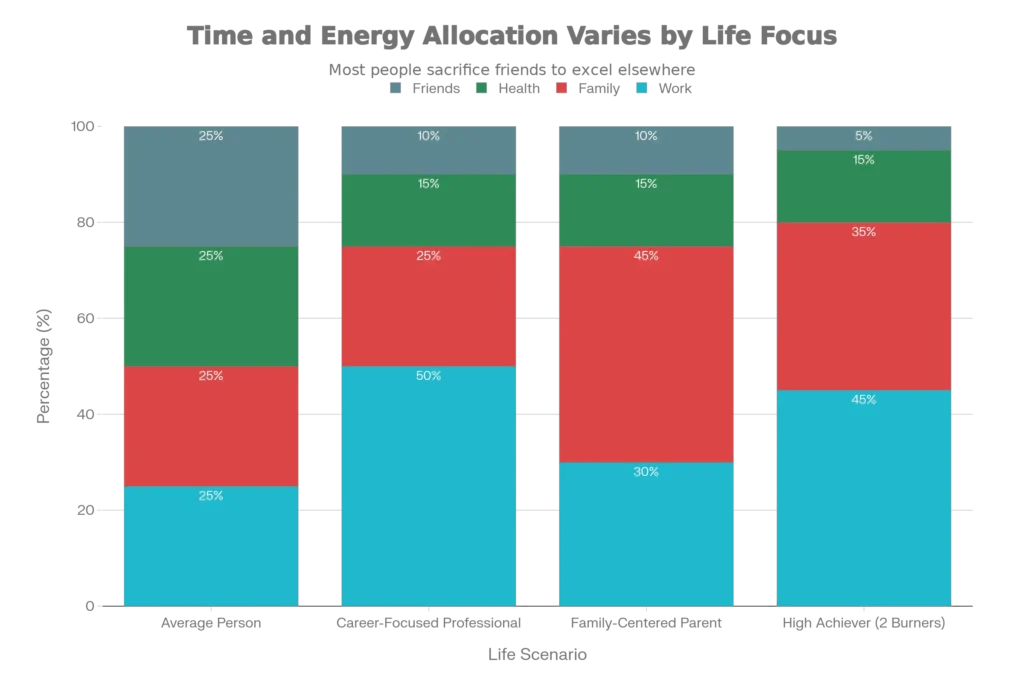
Right now, you might be in a career-building season. Work runs at 70%, health at 60%, family at 70%, friends at 40%. That is okay. But it should not be forever.
Temporary imbalance with a return plan is sustainable. Permanent neglect is not.
2. Maintain a Minimum Flame
Even in intense phases, try not to shut any burner fully off. A short walk. A message to a friend. A meal without screens. Small actions keep doors open.
Research shows that strategic outsourcing—household cleaning, meal delivery, administrative tasks – reduces burnout by up to 30% and helps maintain multiple burners at adequate levels simultaneously.
3. Let Burners Support Each Other
Some activities serve more than one area. Walking meetings. Family workouts. Learning with friends. This does not remove trade-offs, but it stretches the fuel.
The Moore Momentum research calls this the “Five Cores” approach. When designed correctly, burners do not compete. They reinforce each other. Strong health improves work performance. Good relationships reduce stress. Everything connects.
Life Stages Change the Rules
What feels impossible in one decade feels natural in another.
Early career favors work and friends. Parenting years pull energy toward family. Later years shift focus back to health and connection.
Fighting these shifts creates guilt. Accepting them creates clarity.
What to Take Away
The Four Burners Theory is not wrong. It can be considered incomplete.
It explains pressure, not purpose. It explains limits, not life design.
Success does require focus. But fulfillment requires return.
You cannot have it all at once. But you can have different things at different times. And that might be better than having everything at 40% forever.
The goal is not to keep all burners high. The goal is to never forget which ones you plan to turn back on.
Interested in travel, read last week’s LensLetter newsletter about Forget Algorithms Follow Your Creative Heart.
Read last week’s JustDraft about Rule of 40 for SaaS Companies.
Two Quotes to Inspire
Temporary imbalance builds careers. Permanent sacrifice builds regret. The difference matters more than you think.
Burnout is rarely about effort. It is about forgetting what effort was meant to protect.
One Passage From My Bookshelf
The word priority came into the English language in the 1400s. It was singular. It meant the very first or prior thing. It stayed singular for the next five hundred years. Only in the 1900s did we pluralise the term and start talking about priorities. Illogically, we reasoned that by changing the word we could bend reality. Somehow we would now be able to have multiple ‘first’ things. People and companies routinely try to do just that. One leader told me of this experience in a company that talked of ‘P-1, P-2, P-3, P-4, and P-5.’ This gave the impression of many things being the priority but actually meant nothing was. The reality is, saying yes to any opportunity by definition requires saying no to several others. When we don’t purposefully and deliberately choose where to focus our energies and time, other people – our bosses, our colleagues, our clients, and even our families – will choose for us, and before long we’ll have lost sight of everything that is meaningful and important. We can either make our choices deliberately or allow other people’s agendas to control our lives.
📚From “Essentialism: The Disciplined Pursuit of Less” by Greg McKeown.