AI Impact on Jobs in 2026: What the Data Actually Shows
Scroll through X or LinkedIn on any given day and you’ll see the same question everywhere: “Is AI going to take my job?”
My honest answer? It’s wrong question.
The better question is: Are you positioning yourself for what’s coming?
Let me share what the data actually shows – not fear, not hype.
One Topic: AI Impact on Jobs in 2026: What the Data Actually Shows
What Anthropic Just Released
On March 5, 2026, Anthropic (the company behind Claude) published a landmark study, “Labor Market Impacts of AI: A New Measure and Early Evidence“ by economists Maxim Massenkoff and Peter McCrory.
This is beyond theory, as it was built on real Claude usage data across millions of conversations, mapped to 800+ occupations from the US Department of Labor database.
Their headline finding? No mass unemployment. Yet.
The unemployment rate for workers in the most AI-exposed jobs has not increased meaningfully since ChatGPT launched in late 2022. The data is clear on this.
But here’s what did change.
Read detailed report from Anthropic and others here.
The Real Warning Sign – Young Workers
The jobs aren’t disappearing. The entry points are.
Anthropic found that job-finding rates for workers aged 22–25 in AI-exposed occupations dropped 14% compared to 2022. A separate study by Brynjolfsson et al. found a 6–16% fall in employment for the same age group.
Companies aren’t firing experienced people. They’re simply not hiring as many junior ones. One senior engineer with AI tools now handles what used to need a team of three. Why hire two entry-level analysts when your senior analyst and Codex/Claude can cover the same work?
The “learning ground” roles – first drafts, data entry, basic research, initial code are getting automated first. And those were the roles that used to train the next generation.
Who Is Most Exposed?
This surprised most people. The most AI-exposed workers are actually more educated, higher paid, and more likely to be female than those with zero exposure. They earn 47% more on average.
Top exposed occupations (Anthropic data):
- Computer Programmers – 75% task coverage
- Customer Service Reps – 70%
- Data Entry Keyers – 67%
- Financial Analysts – 57%
And 30% of workers cooks, bartenders, mechanics, lifeguards have zero AI exposure. AI still can’t fix a carburettor or read a room.
This flips the old automation story. This isn’t factory workers again. It’s white-collar knowledge work.
My Take: The Shift That’s Actually Happening
AI doesn’t eliminate roles. It eliminates redundant tasks within roles. And that freed-up time creates space for new kinds of work, roles we’re only beginning to name.
- Engineers → Engineering Managers. As AI handles more code generation, the premium shifts to people who understand system architecture, direct AI effectively, and can explain technical trade-offs to non-technical teams. AI writes code. It doesn’t decide what to build or why.
- Analysts → Data Storytellers. AI can generate a 40-page report in minutes. But someone still needs to say: “Here’s the one number that matters, and here’s what we do about it.” That is a deeply human skill.
- Marketers → AI Content Strategists. The job isn’t to write anymore – it’s to direct AI output, maintain brand voice, and design campaigns that actually convert.
- New roles entirely: AI Workflow Designer, Prompt Strategist, Corporate AI Trainer. These didn’t exist three years ago.
The pattern is the same across every field: routine tasks get automated, judgment becomes premium.
There’s also something worth noting about women in the workforce. LinkedIn data shows women hold a meaningfully higher share of interpersonal leadership skills collaboration, emotional intelligence, team leadership. As AI absorbs more analytical busy work, these skills become more valuable, not less. The professionals I see moving fastest with AI are women who are combining technical adoption with those strengths.
What You Should Do Right Now
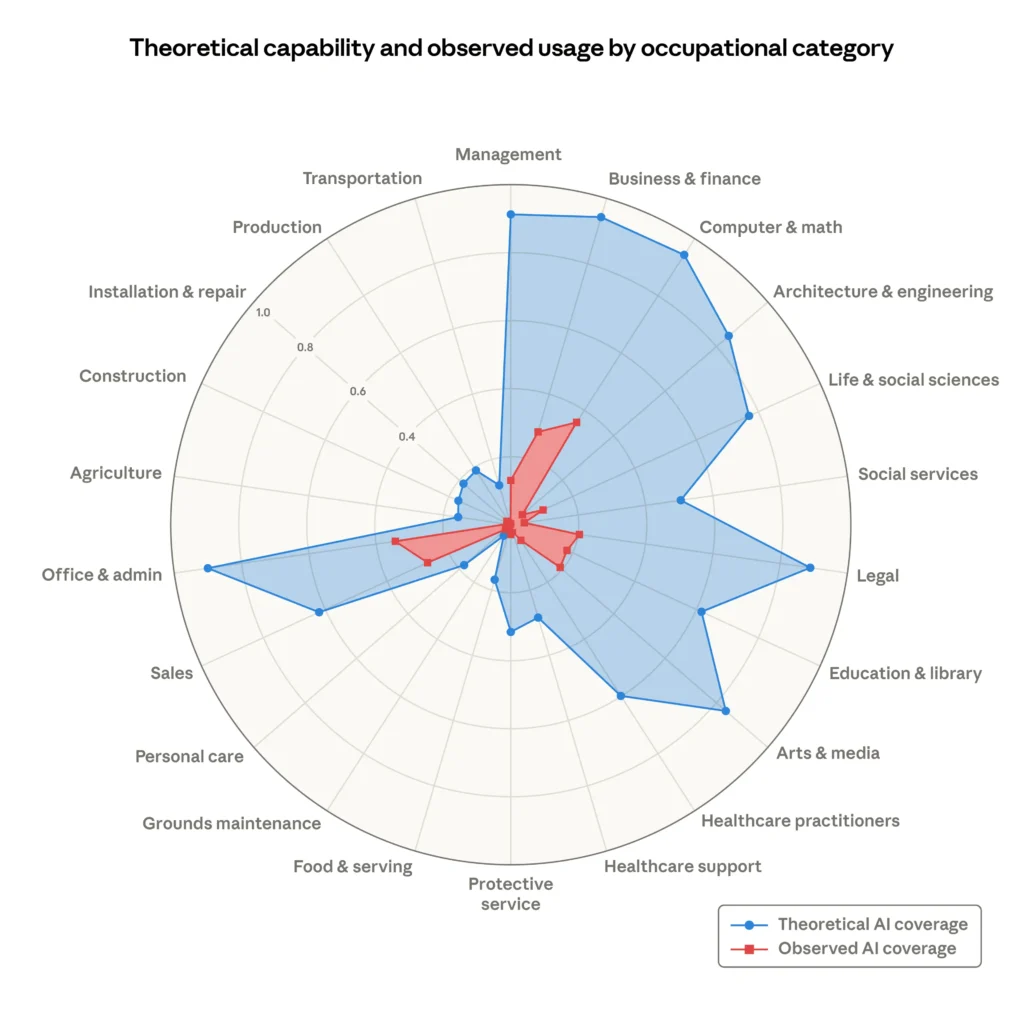
The gap between AI’s theoretical capability and what’s actually being used in workplaces is still enormous. Anthropic’s data on AI impact on jobs shows AI is only covering 33% of what it’s theoretically capable of in professional settings. That gap is your window.
Three things worth doing as I also shared couple of weeks:
- Use AI for one real work task daily. Not reading about it, using it. Reports, emails, analysis. 30 minutes a day for two weeks will teach you more than any course.
- Identify which part of your job is truly yours. What requires judgment, relationships, creativity? Double down on that.
- Move toward coordination, not just execution. The roles growing fastest require directing people and AI – not just doing the task yourself.
Upskilling isn’t optional anymore. The data is telling us the window is open right now. Most professionals haven’t started.
That head start is worth more than you think.
Interested in travel or photography, read last week’s LensLetter newsletter about importance of first lens.
Read last week’s JustDraft about Perplexity Computer.
Two Quotes to Inspire
The professionals who thrive in an AI world are not the ones who fear the tool, they’re the ones who learn to direct it before everyone else does.
True leadership in the AI era is knowing when to trust automation and why human thinking still matters.
One Passage From My Bookshelf
In Chapter 2, Epstein contrasts “kind learning environments” (like golf or chess, where rules are fixed and feedback is immediate) with “wicked learning environments” (like real-world business and strategy, where rules change, feedback is delayed, and patterns are non-obvious). He argues that in wicked environments — which describe almost every professional role touched by AI — people with broad, transferable skills and the ability to learn across domains consistently outperform narrow specialists. The implication for the AI era is direct: the professionals most likely to adapt are those who have practiced learning new frameworks, not just those who have optimized for one set of tasks.
📚 From Range: Why Generalists Triumph in a Specialized World by David Epstein