AI for Leaders: A Step-by-Step Enterprise Strategy Blueprint
I’ve been watching something fascinating unfold over the past year.
Companies are pouring millions into AI. Everyone’s talking about transformation. Yet when I look at the numbers, something doesn’t add up. McKinsey’s latest research shows that while AI adoption has surged, only 1% of organisations have actually achieved AI maturity. That’s not a typo – 1%. The other 99% are stuck somewhere between expensive experiments and broken promises.
Here’s what caught my attention: this isn’t a technology problem. It’s a leadership gap. And the gap is getting wider.
One Topic – AI for Leaders: How to Leverage Artificial Intelligence (AI)
The Real Numbers Behind AI Failure
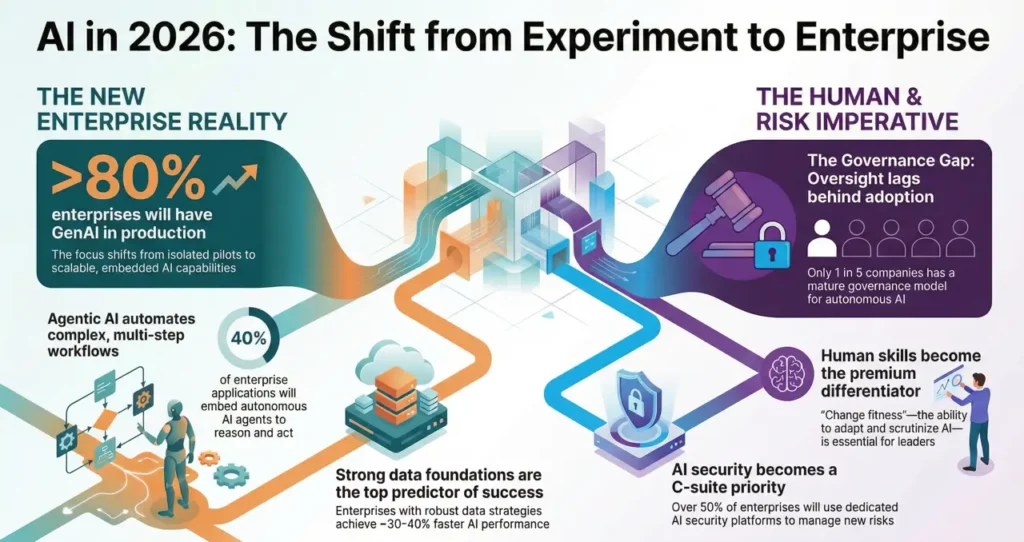
McKinsey’s latest research shows something startling: organisations with strong executive commitment to AI are 3 times more likely to succeed than average adopters. Meanwhile, 95% of generative AI pilots fail to create enterprise value.
Why? Because leaders are asking the wrong questions.
Most organisations approach AI thinking, “How can we automate what we do?” The winners ask, “What can we do now that we couldn’t before?”
That’s not a technical distinction. It’s a strategic one.
The Leadership Gap Nobody Wants to Admit
Gartner’s 2025 CEO Survey exposed an uncomfortable truth: 77% of CEOs know AI will transform their business, yet 66% admit their business models aren’t ready for it. Even more telling only 44% of CEOs view their CIOs as AI-savvy.
The capability gap is real, and it’s expensive. Organisations investing in executive AI literacy will achieve 20% higher financial performance by 2027 compared to those that don’t.
But here’s what AI literacy doesn’t mean: learning to code or understanding algorithm mathematics.
It means developing five strategic capabilities:
- Strategic thinking – Can you diagnose where AI creates genuine value versus hype? When your team proposes an AI project, can you evaluate if the business case is sound
- Governance – Do you understand how to manage AI systems with the same rigor as financial reporting? What questions should you ask about bias, risk, and compliance?
- Change management – AI succeeds or fails because of people, not technology. Can you guide teams through role redesign and address concerns transparently?
- Value measurement – Are you defining clear metrics that connect AI investments to business outcomes, not just technical accuracy?
- Data strategy – Do you understand how data flows through your organisation and whether your infrastructure can support AI at scale?
If you can’t answer these confidently, you’re not ready to lead AI transformation.
From Pilots to Performance: What Actually Works
The pattern is consistent across research: successful organisations don’t run 50 small pilots. They select 3-5 strategic initiatives where AI creates significant impact.
They start by redesigning workflows, not optimising existing processes. As EY puts it: “Drop the 56 steps you did in the past and start with a clean sheet of paper, because AI fundamentally changes that operating system.”
This requires rethinking three things:
- Your operating model. AI-native businesses don’t layer AI on top of human processes. They design workflows assuming AI as a core resource, with humans focusing on judgment, relationships, and strategic decisions.
- Your investment focus. High performers are shifting budgets from cost reduction to growth and innovation. Why? Cost reduction has limited upside. Building AI-enabled new revenue streams can generate exponential returns.
- Your governance structure. The days of “let’s experiment and figure out governance later” don’t exist anymore. Form a cross-functional AI governance board now – technology, operations, finance, legal, HR. Define decision rights. Document policies before you scale.
The Agentic AI Wave You Can’t Ignore
While most companies struggle with basic AI adoption, the next wave is already here: autonomous agents.
These aren’t chatbots. They’re AI systems that can plan multi-step sequences, reason about alternatives, and learn from outcomes all autonomously within defined guardrails.
Gartner predicts 40% of enterprise applications will embed AI agents by end of 2026. Organisations implementing multi-agent coordination report 40% improvements in cross-functional workflow efficiency.
But here’s what matters for you as a leader: agents require fundamentally different thinking about workflow design, governance, and human roles.
You cannot treat agents as expensive robots replacing workers. You must redesign work around what agents are good at – context-aware decision-making, 24/7 availability, multi-step planning, and what humans are irreplaceable for: strategic judgment, customer relationships, ethical decisions.
Your Humanity Is Your Competitive Advantage
Here’s the paradox of the AI era: as machines absorb more analytical and routine tasks, your uniquely human capabilities become more valuable, not less.
AI can process infinite data, but it cannot replicate genuine connection, navigate ambiguity with wisdom, or make ethical trade-offs when stakes are high.
The leaders who win in 2026 aren’t those who implement AI most efficiently. They’re those who double down on irreplaceable human skills:
Judgment when information is incomplete. Empathy to build trust amid constant change. Creativity to imagine possibilities that transcend historical patterns. Ethics to ensure technology serves human goals, not the other way around.
The Clear Path Forward
Based on research from McKinsey, Gartner, and industry experts, here’s what you need to do:
- Immediate: Take AI literacy seriously. Form your governance board. Audit current AI efforts and map them against strategy.
- Next 90 days: Develop your AI strategy. Select 3-5 high-impact workflows to transform. Establish governance policies and begin your data audit.
- By year-end: Launch pilots with rigorous ROI tracking. Invest in talent development. Prepare for workflow redesign.
The research is clear: by 2027, AI literacy will predict 20% financial performance differences. The gap between winners and losers is widening fast.
The question isn’t whether you’ll adopt AI. It’s whether you’ll lead with it or let it lead you.
Interested in travel or photography, read last week’s LensLetter newsletter about Apple new Creator Studio with AI.
Read last week’s JustDraft about The Truth About Work Life Balance.
Two Quotes to Inspire
The best AI strategies don’t optimise what you do – they reimagine what’s possible. The difference between incremental and exponential is a leadership decision.
The best leaders don’t just adopt the future; they design the human space within it. Your role is not to manage algorithms, but to lead people.
One Passage From My Bookshelf
The Lean Startup method is not about cost, it is not about failure, it is about speed. Validated learning is the process of demonstrating empirically that a team has discovered valuable truths about a startup’s present and future business prospects. It is more concrete, more accurate, and faster than market forecasting or classical business planning. It is the principal antidote to the lethal problem of achieving failure: successfully executing a plan that leads nowhere.
Validated learning is the gold standard for startups, but it requires a new accounting framework. Traditional accounting measures historical performance; what we need is entrepreneurial accounting, designed to evaluate whether we are making progress toward our vision. This is radically different from traditional accounting because it uses innovation accounting to measure progress in product development even when you don’t yet have traditional accounting numbers. The goal of a startup is to figure out the right thing to build the thing customers want and will pay for as quickly as possible. In other words, the Lean Startup is a new way of looking at the development of innovative new products that emphasizes fast iteration and customer insight, a huge vision, and great ambition all at the same time.
📚From “The Lean Startup” by Eric Ries